
Signs the main line is clogged
- Several drains back up at once, not just one.
- A toilet gurgles when the washer drains.
- Water appears in the basement floor drain.
- Sewage smell in the basement or yard.
- A slow main that clears and returns within weeks.
If sewage is coming up in your home right now, stop using water and call. Our sewer line cleaning crew answers 24/7.
What changes the price
| Factor | Why it moves the cost |
|---|---|
| Access | A clean-out makes the job simple, and no clean-out means more setup |
| Length and depth | Longer or deeper lines take more time and equipment |
| Cause | Grease and paper clear easily, roots and collapses do not |
| Method | Cable, jetting or excavation carry very different costs |
| Camera inspection | Shows the cause so you pay for the right fix |
| Time of day | Emergency hours cost more than scheduled visits |
We give a clear price before work starts. We do not post a dollar figure because the cause is not known until the line is inspected.
Clearing versus repairing
Clearing a clog
- Cable or jetting opens the line
- Fast, often the same visit
- Does not fix a damaged pipe
Repairing the pipe
- Spot repair, relining or replacement
- Needed for breaks, bellies and root intrusion
- Costs more but stops repeat clogs
A clog that returns means the pipe has a defect. Use a camera to see it. Our sewer inspection page explains what you get.
Roots, grease and old pipe
In neighborhoods built in the 1950s and 1960s, the main line may be clay or cast iron. Clay joints let roots in, and cast iron scales inside over decades. Hydro-jetting clears many of these, but it cannot rebuild a collapsed section.
Grease is a household cause. Do not pour cooking fat down kitchen drains, and keep wipes out of toilets. See hydro-jetting for a cleaning method that scours the walls.
The North Olmsted angle
Under North Olmsted Codified Ordinance 911.07(c), the property owner is responsible for the building sewer, the pipe that runs from the house to the city main. That means a clog or break on your side of the connection is generally your cost. The city has its own wastewater treatment plant and maintains the public main, so a blockage in the street main is a different call. Ask the Engineering Department if you are not sure where your responsibility ends.
Is it the city main or your line?
If only your home backs up, the problem is usually on your side. If neighbors also have backups, the main may be blocked. A camera run from your clean-out shows whether the blockage is on your pipe or past your property line.
If you suspect the city main, call the city. If it is yours, call a plumber. When in doubt, a camera visit gives you proof either way.
Ways to keep costs down
- Install a clean-out if you do not have one.
- Schedule a camera inspection before a house purchase.
- Treat slow drains early, before they turn into a full stoppage.
- Keep roots in check with periodic cleaning if you have trees near the line.
- Ask whether a backwater valve fits your home.
A backwater valve can help stop sewage from entering the basement, and the city has a policy on installing one. For towns beyond North Olmsted, our Fairview Park and Westlake pages describe local sewer notes.
What happens during a camera inspection
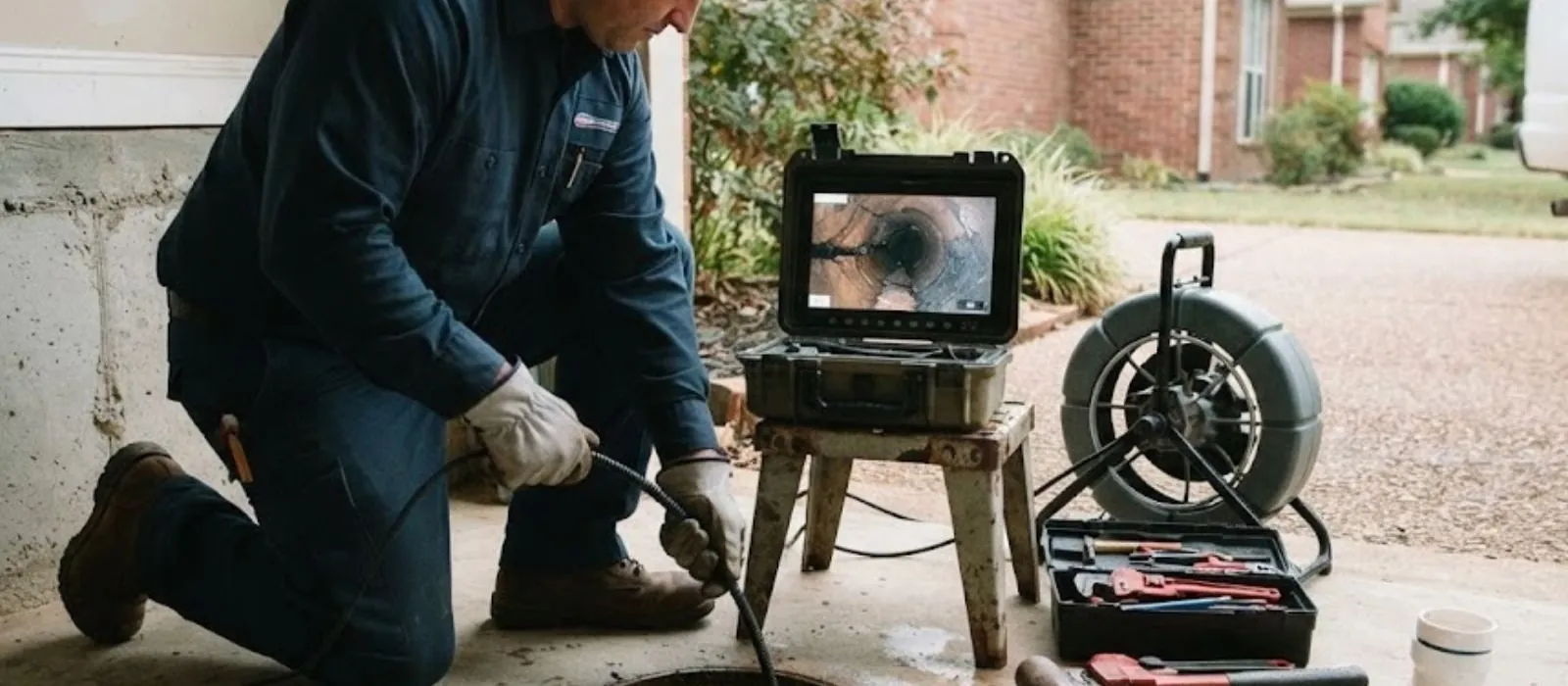
A technician feeds a flexible camera down the clean-out and watches the live picture. The camera shows the pipe material, the joints, any roots, any belly where water pools and the exact spot of a break. The operator can mark the depth and location above ground.
You get a clear answer about what is wrong and where. That is how a quote moves from a guess to a number, and it is why we recommend a camera before any major sewer repair.
Questions to ask before you approve work
- What is the cause of the clog, and can you show me on camera?
- Will this clear the line or fix the cause?
- What happens if the clog returns, and is there a guarantee period?
- Is the price a fixed number or an estimate that can change?
- Who will pull a permit if the work needs one?
A good contractor welcomes these questions. Written answers protect you if the scope changes.
What to do while you wait for the plumber
Stop running water in the house, including laundry and dishwashers. Every gallon you send down a blocked line has to go somewhere, and it often ends up in the lowest drain, which is the basement.
Keep people and pets away from the affected area and avoid contact with sewage water. Do not mix drain chemicals, and do not use them on a main line blockage, because they can splash back and hurt the plumber.
If water is already on the floor, turn off the power to the area if you can reach the panel safely, and take photos for insurance. Move valuables to higher ground. Our sewer line repair page explains what happens once the line is open.
Preventing the next backup
Keep grease, wipes and paper towels out of the drains. Have the line cleaned if you notice repeat slowdowns, and consider a periodic camera check if the house is older or has large trees near the sewer.
A backwater valve can protect the basement if the public main surcharges in a storm, and the city has a policy on installing one. Talk to your plumber about whether it suits your house.
Written scope protects you
Before work starts, ask for the scope in writing. It should state the method, the length of line, the area covered and what is not included.
If the plumber finds something unexpected, such as a collapsed section, the scope tells both sides when the price needs a new conversation. That clarity prevents arguments later.
Code reference for sewer cleanouts
The International Plumbing Code (IPC), which the Ohio Plumbing Code follows, calls for accessible cleanouts on building sewers. A house without one costs more to service, which is one reason a cleanout is often the first thing a plumber suggests.
Questions homeowners ask
It depends on access, length, cause and method. We give a price before work starts, after we know what is blocked.
The property owner is responsible for the building sewer under the city code. The city handles the public main.
It is a separate step, but it shows the cause and can save money on the repair.
It may if the pipe is damaged or roots remain. A camera shows whether a repair is needed.
A small drain snake can work on a simple clog. A main line usually needs a heavier machine and a camera.
Have a question that is not here? Call (440) 468-0237.