
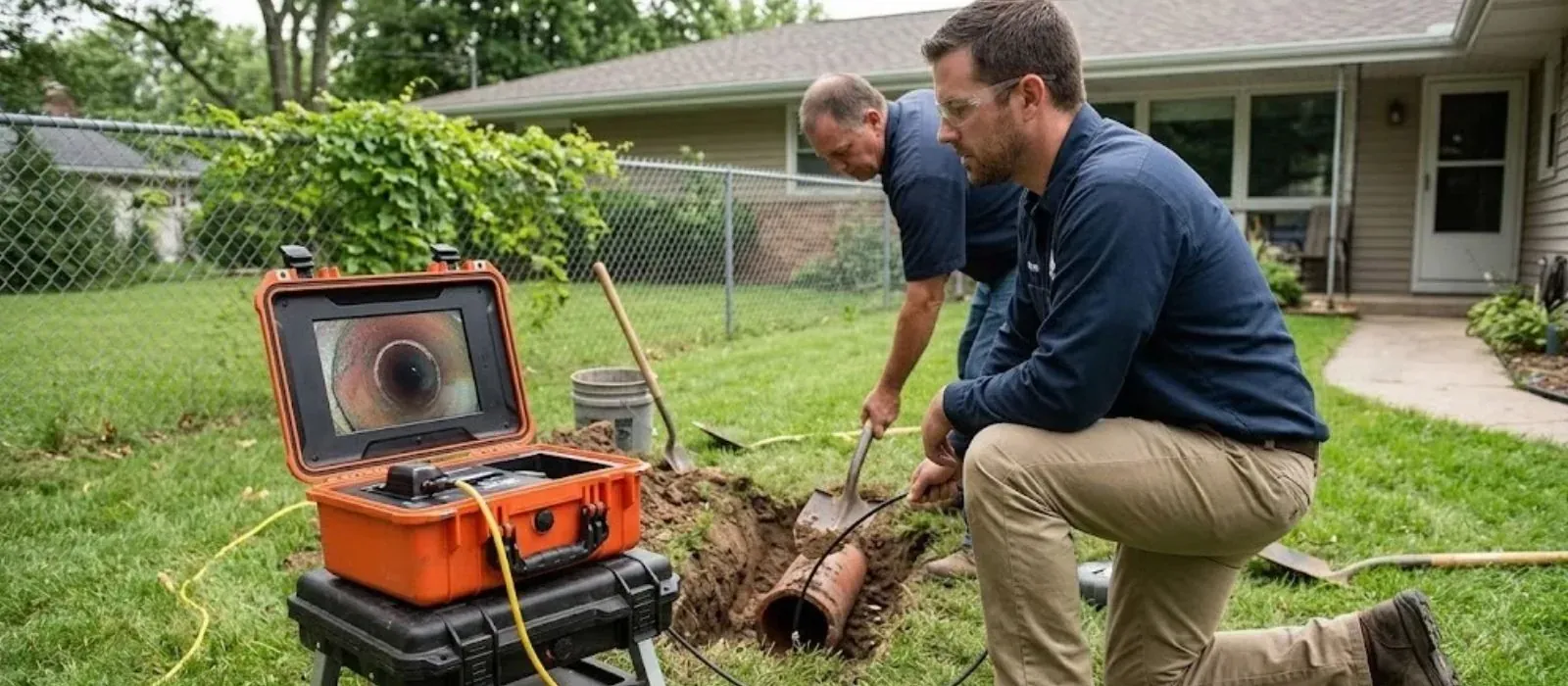
A sewer camera inspection pushes a waterproof camera through your drain line and records what it sees. You get a look at pipe material, joints, roots, buildup and damage without digging anything up.
Most calls come from two situations. One is a house that keeps backing up. The other is a buyer who wants to know what is under a 1960s ranch before closing. Call (440) 468-0237 to schedule a camera visit.
What the camera can show
- Pipe material, such as cast iron, clay, plastic or a mix that changes along the run.
- Roots entering at joints and how much of the pipe they fill.
- Cracks, offset joints and sections that have collapsed.
- Bellies, where the pipe sags and holds water and waste.
- Scale and grease buildup that narrows the opening.
The location of a problem can also be marked at the surface using a locator, which saves digging in the wrong spot. This is useful before any sewer line repair is planned.
Inspecting a house before you buy
A home inspection usually covers visible plumbing but not the underground sewer lateral. For a house built in the 1950s through the 1970s, a camera inspection fills that gap.
Ask the seller for access to the cleanout, and schedule the camera before the inspection contingency ends. Roots or a collapsed section found now can be negotiated. The same finding after closing is yours to pay for.
When to book a camera inspection
| Situation | Why a camera helps |
|---|---|
| Two backups in a year | Shows whether the pipe is damaged or just dirty |
| Slow drains throughout the house | Separates a main line problem from fixture clogs |
| Buying an older home | Reveals problems before closing |
| Soft ground over the sewer path | Confirms whether a leak is the cause |
| After jetting or cabling | Verifies the pipe is clean and sound |
If the camera finds only buildup, sewer line cleaning usually solves it.
What a visit looks like
The technician finds the cleanout, runs a cable if the line needs clearing first, then feeds the camera down the pipe while a monitor shows the live picture. You can watch along and ask questions.
Afterward you get a plain explanation of what the footage shows. When video is recorded, you can ask for a copy for a contractor, an insurer or a home purchase.
A note on local sewer rules
In North Olmsted the owner is responsible for the building sewer, which is the pipe from the house to the public connection. The city separates sanitary and storm sewers and prohibits tying downspouts or foundation drains into the sanitary line.
A camera can reveal an illegal connection. If you receive a city notice about a connection, the city requires a dye test performed by a registered plumber. We can inspect the line and discuss next steps.
What common findings mean
| What the camera shows | What it means | Usual next step |
|---|---|---|
| Fine root hairs at joints | Roots entering small gaps | Jetting, then a sealing plan |
| Offset or separated joint | Pipe has shifted | Spot repair or lining |
| Bellied section holding water | Pipe has sagged | Dig and regrade that section |
| Flaking, scaled cast iron | Corrosion from inside | Clean and monitor, or replace |
| Clean, intact pipe | No action needed | Keep the footage for your records |
Not every finding needs an immediate repair. We help you rank them so you spend on what matters first.
Private lateral versus public main
The camera follows your line up to the public connection and sometimes a short way beyond. Defects on your side are yours to fix. A problem in the public main is for the city to address.
If the video suggests a defect at or beyond the connection, we tell you and suggest you notify the city wastewater collection office. Documentation helps that conversation.
What affects the price of a camera inspection
What drives the cost of a camera visit
The quote arrives before the first fitting is touched. Standard homeowners policies rarely pay for inspections, but some insurers ask for one after a claim. Ring (440) 468-0237 with the details and we will talk it through.
Want to see inside your line?
Call to book a camera visit. Tell us if you are buying or fighting repeat backups.
Questions about sewer inspection
Many residential inspections take under an hour once the camera is in the line. A line that needs cleaning first takes longer.
Yes. A locator on the camera head lets the technician mark the spot on the ground and estimate depth, which narrows any excavation.
It helps a great deal. Without one, the camera can sometimes go in through a toilet flange or a floor drain, but it takes more time.
It shows the sewer line it travels through. It does not show supply lines, inside-wall leaks or fixtures. For those, see our leak detection page.
For a house built before about 1980, it usually is. The Census survey profile shows most North Olmsted homes fall in that range, and underground sewer lines are rarely covered by a standard inspection.
Questions about the camera visit? Call (440) 468-0237.