
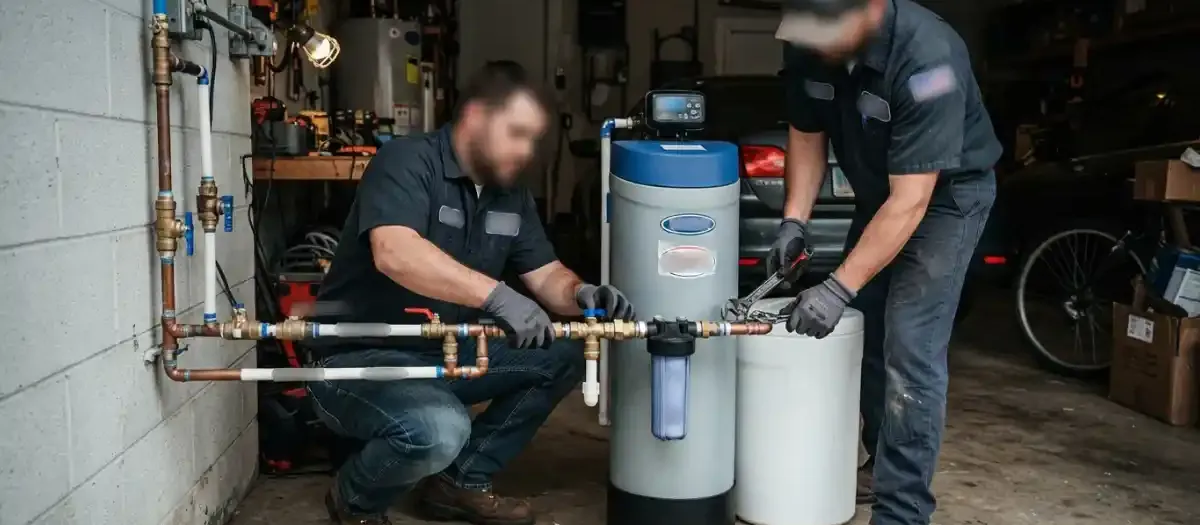
What the softener needs from your plumbing
A water softener is a tank of resin plus a brine tank and a control valve. It needs a place on the cold main, a drain for regeneration, an electrical outlet and room for salt delivery.
The plumbing is the easy half. Locations and drains cause most of the surprises.
Choose the location
- After the main shutoff and meter, before the water heater.
- Before the branch to outdoor spigots, so lawn water is not softened.
- Near a floor drain or laundry standpipe for the drain line.
- Near an outlet, off the floor if flooding is a concern.
- In a frost-free area with room to refill the brine tank.
A softener on the cold line before the heater protects the heater and every fixture. Keep one cold tap unsoftened for drinking if you prefer it.
The plumbing parts
| Part | Purpose |
|---|---|
| Bypass valve | Isolates the softener for service without shutting the house water |
| Inlet and outlet connections | Copper, PEX or flexible connectors matched to your pipe |
| Drain line | Carries regeneration water to a drain with an air gap |
| Brine overflow | Safety line from the brine tank to a drain |
| Hardness test kit | Lets you set the right capacity and regeneration |
A proper air gap in the drain prevents sewer water from being drawn back into the unit.
The North Olmsted angle
In its 2025 water quality report, the Cleveland Water system shows hardness spanning 105 to 130 ppm and averaging 117. Moderate hardness like that leaves scale in heaters and fixtures over time. The report describes the system as a whole, not your street, so test your own tap or ask your utility. If your house is served by a different water supplier, ask that supplier for its report.
Sizing the softener
Capacity depends on hardness and how many people use water. The control valve uses these numbers to decide how often to regenerate. A softener sized too large wastes salt, and one sized too small regenerates constantly.
Ask your installer to size it using a real test of your tap, not a guess. Our water softener and filtration page explains what we check.
What to know about drains and sewer rules
Regeneration water goes to a drain, and in some places local rules limit it. Check with the city plumbing office if you are unsure. Do not discharge to a septic system without the manufacturer approval.
Pay attention to a sump pump pit. Discharge into a sump is not allowed everywhere, and Section 911.07(j) in North Olmsted bars connecting clear water to the sanitary sewer. Ask before you pipe the drain line into the sump.
Installation steps for a plumber
Shut off and drain
Close the main and open a low faucet to relieve pressure.
Cut in the bypass
Install the bypass and connections on the cold line.
Run the drain
Route the drain line with an air gap to the standpipe or floor drain.
Load and start
Add salt, program hardness, flush the resin and check for leaks.
After the install, test the water at several fixtures and note the hardness setting. For heater-side work, see water heater installation.
Where we install
We install in North Olmsted and in Westlake and Olmsted Township. Water suppliers differ by town, so we ask which one serves you before we recommend a setting.
Salt, maintenance and running costs
A softener uses salt to recharge its resin, and you will refill the brine tank a few times a year depending on hardness and household size. Use the salt type the maker recommends. Bridging, where a crust forms above the water in the tank, can stop recharging, so check the tank now and then.
The control valve uses a small amount of electricity and the regeneration cycle uses water. Efficient valves regenerate based on actual use instead of a fixed calendar, which saves salt and water.
Softened water and your lawn, plants and drinking water
Softened water contains more sodium than hard water. Keep outdoor spigots on the hard side so you do not water the lawn with it, and ask your doctor if you are on a sodium-restricted diet. A separate cold tap or a reverse osmosis filter can supply unsoftened drinking water.
Installers often put the softener after the outdoor line branches for this reason. Tell your plumber if you have a garden, because it changes where the unit connects.
Choosing between a softener and other options
A salt-based softener removes hardness minerals by ion exchange. A salt-free conditioner changes how minerals behave but does not remove them, and its results vary. A filter does not soften at all.
If scale on fixtures and in the water heater is your problem, a softener is the proven tool. If you only want better taste, a filter is cheaper and simpler. Some homes use a softener for the house and a filter for drinking water.
Think about maintenance too. A softener needs salt and an occasional cleaning, and a conditioner needs little. Write down what you want to fix, then match the tool to it.
Questions to ask your installer
Ask where the bypass will be, how the drain will be routed, how the hardness was measured and what salt the unit uses. Ask what happens with the warranty if someone else services it.
Also ask what the plan is for a power outage. Most softeners hold their settings through a short outage, but a long one can delay a regeneration. A clear answer shows the installer has thought about your house.
A note on testing your hardness
Store-bought test strips give a rough reading, and a lab or a plumber with a titration kit gives a better one. Test the cold kitchen tap after letting the water run for a minute.
Write the result down and give it to your installer. The number sets the capacity and the regeneration schedule, so a bad reading leads to wasted salt.
Code reference for the drain
The International Plumbing Code (IPC), which the Ohio Plumbing Code follows, requires softener waste to discharge through an air gap or other approved indirect connection. Ask your installer to show you the air gap before they close up the job.
Questions homeowners ask
Not always, but cutting into the main line and building a code-correct drain is best done by a plumber.
On the cold main after the shutoff and meter, before the water heater, with a bypass.
Yes. It discharges regeneration water, and the drain must have an air gap.
Cleveland Water reports 105 to 130 ppm, which is moderately hard. Test your tap to confirm.
No. Low pressure comes from other causes, and a clogged softener can make it worse.
Have a question that is not here? Call (440) 468-0237.