
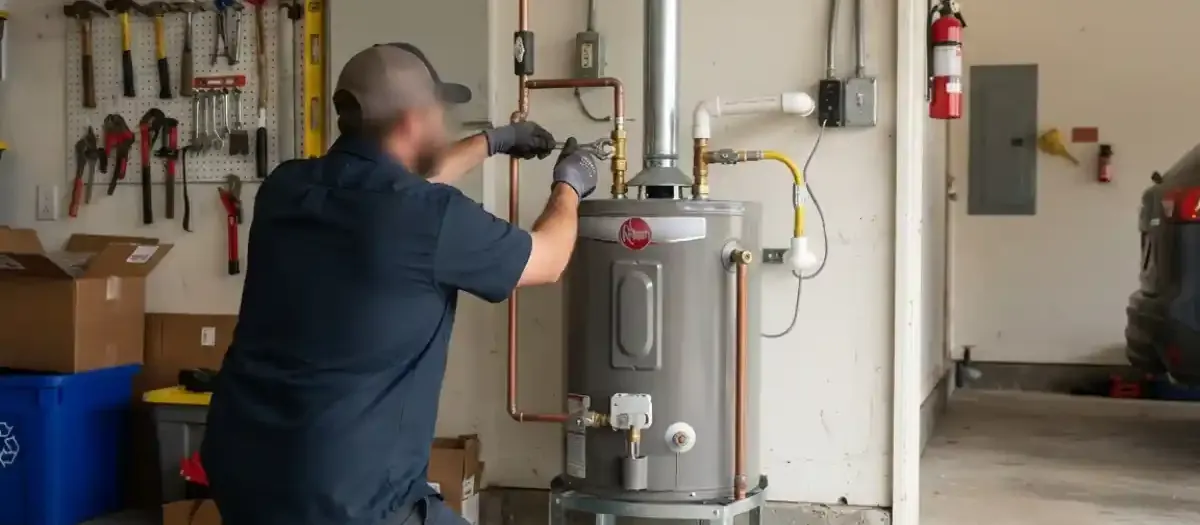
Water heater installation covers more than a swap. It includes choosing the size, fuel and location, running supply and venting, adding an expansion tank and relief piping, and getting the permit.
If your current heater has failed, see water heater replacement. For a planned job, call (440) 468-0237 and tell us what you want to change.
Planning the install
A good install starts with questions. How many bathrooms are there? Does anything run at once? Is there a floor drain nearby? Where does the vent go? Those answers decide the unit and the cost.
In a house with a basement, the old heater location is usually the best, since the supply, vent and drain already exist. Moving it adds work but can free space or shorten pipe runs.
Common planned installs
Fuel change
Gas to electric or hybrid, or the reverse, with new circuits or gas piping.
Relocation
Moving the heater during a basement finish or kitchen remodel.
Capacity upgrade
A larger tank or a second unit for a bigger household.
New construction
Fresh installs with rough-in coordinated with the build.
Code items that belong in every install
- Relief valve with a discharge pipe that ends at a safe point.
- Expansion tank where the plumbing is a closed system.
- Drain pan or floor drain where leaks could cause damage.
- Proper venting for gas units, with combustion air.
- Shutoff valves within reach and clear labeling.
Permits, inspections and what North Olmsted says
The city lists its plumbing code as the 2024 Ohio Plumbing Code, based on the 2021 International Plumbing Code. The city Building Division issues the permit, and the application says the permit holder arranges inspections with 24 hours notice.
Contractors must register with the city before permits are issued. Rules vary by job, so ask the Building Division at 5200 Dover Center Road whether your project needs a drawing.
Hard water and your new heater
Mineral scale shortens water heater life. Cleveland Water's 2025 report lists hardness at 105 to 130 ppm, averaging 117, which is moderately hard. Test your tap and ask your utility which report applies to your street.
A water softener or filter can protect a new heater. Flushing a tank once a year also helps.
Problems we correct on older installs
A water heater set in the 1960s or 1970s may have no drain pan, a relief pipe that stops short of the floor or a vent pipe with a sag in it. Those are not always flagged until a leak or a failed inspection.
During a planned install we check the supply shutoff, the condition of the unions and the vent slope. If a galvanized nipple is rusted through, we replace it rather than reconnect it. Fixing these at install time costs little compared with a flooded basement later.
If the house has had hot water problems for years, the heater may not be the cause. Low pressure or discolored water can point to supply piping, which is why we mention leak detection when readings look odd.
Venting and combustion air for gas units
A gas water heater needs a vent that carries exhaust outside and enough air to burn properly. Many older basement installs share a flue with a furnace, and replacing one appliance can change how the vent performs.
We check the vent size, slope and condition during the plan. A high-efficiency power vent uses plastic pipe through a wall, which changes the layout. Tell us if the basement is finished or has limited wall access.
Electric and heat pump requirements
Electric tanks need a dedicated circuit sized to the unit, commonly 30 amps for a standard model, though the label decides. Heat pump models need the same type of circuit, floor space and airflow, plus a condensate drain.
A heat pump unit cools the room it sits in and works best in a space with some volume. A small closet may need louvered doors or ducting. We tell you before you buy whether the space works.
What affects the price of water heater installation
What drives the cost of a planned install
Before we open a wall or a valve, you know what the job will cost. Planned jobs let you compare options and schedule around your life. Insurance does not cover planned upgrades. Call (440) 468-0237 and we will walk through the cost.
Planning a new heater?
Call and tell us what you want to change. We will plan it with you.
Questions about water heater installation
Replacement swaps a failed unit in place. Installation includes planned changes such as a new location, fuel or capacity.
Yes. It needs room for airflow and a condensate drain, and your electrical panel must support it.
If your plumbing is a closed system, which is common with a backflow preventer or pressure reducing valve, an expansion tank is typically required. The technician checks.
Usually, if supply, venting and drain can follow. It adds cost, so the plan should explain the trade-off.
A simple swap can be a few hours. A fuel change or relocation can take a day or more.
Planning questions? Call (440) 468-0237.