
If water will not stop, close the shutoff valve under the sink or, if there is none, the main water valve. Then call (440) 468-0237. We take fixture emergencies 24/7.
Faucet and valve problems fall into two groups. Some are a worn part that costs little to replace. Others involve a corroded valve that will not close, which needs a plumber and sometimes a new valve.
When a faucet or valve is an emergency
A leak at a shutoff valve, a faucet that will not close or a shower valve that drips inside the wall can flood quickly.
- Water spraying from a supply line or valve stem.
- A shutoff valve that will not turn or leaks when turned.
- A shower valve that cannot be shut off or leaks inside the wall.
- Water at the base of a faucet that grows over minutes.
Close the main water valve if you cannot isolate the fixture. If the main valve will not close, that is a separate repair we handle quickly.
Kitchen and bath faucets
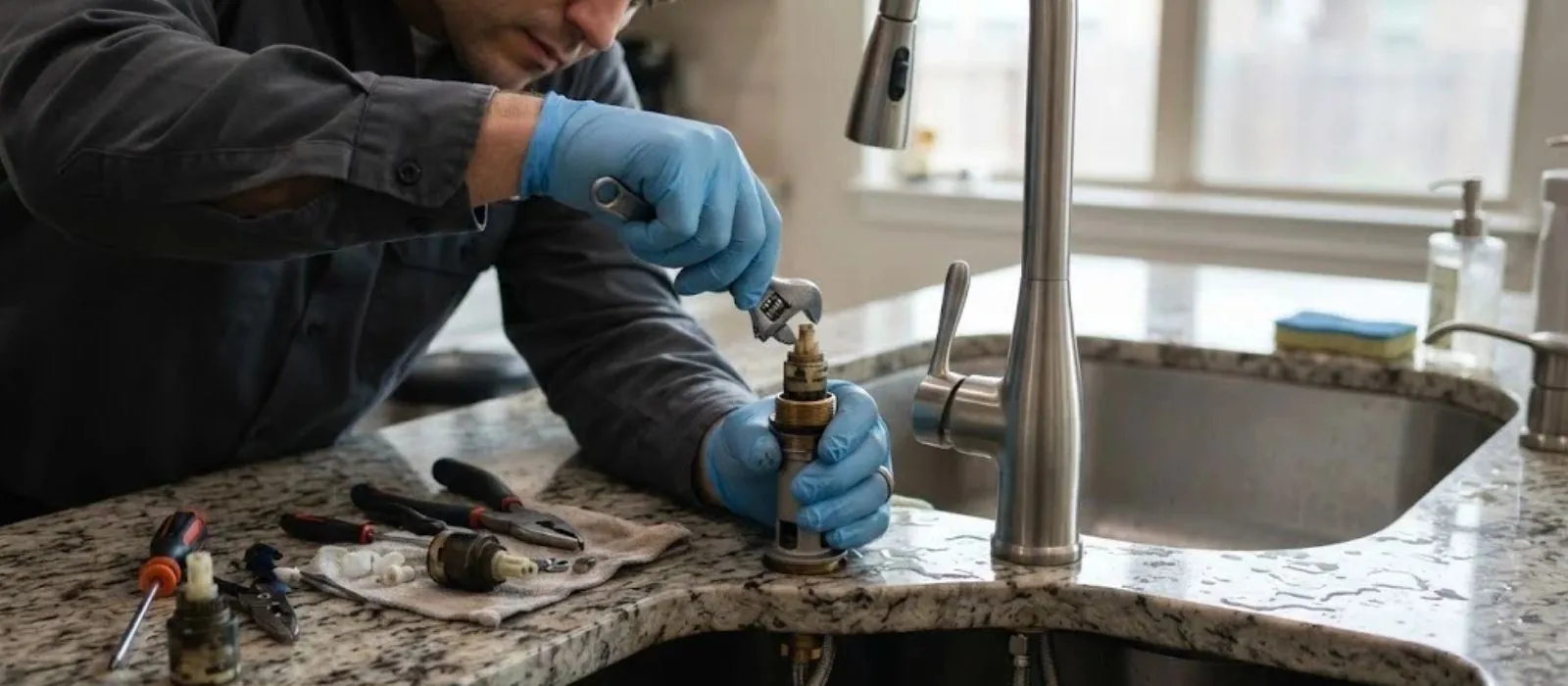
Most faucet leaks come from a worn cartridge, ceramic disc or O-ring. We identify the brand, replace the cartridge and test for drips. If the faucet is old and parts are unavailable, we suggest a new one.
A new faucet is often a better value than a repair on a chrome unit that has corroded. Bring the make and model if you know it, or send a photo before the visit.
Shower valves and tub faucets
A shower that drips from the head after you turn it off has a worn valve cartridge. A tub spout that leaks while the shower runs has a failing diverter.
When the valve sits behind tile, we check whether an access panel exists. Valve replacement through a small opening is possible in many layouts. A leak inside the wall can cause damage, so call sooner rather than later. If you suspect moisture inside a wall, see leak detection.
Shutoff valves and supply lines that fail
Old shutoff valves, called angle stops, seize from mineral buildup. They can crack when turned. Supply lines under sinks can burst, particularly braided lines with corroded fittings.
| Part | Sign it is failing | Fix |
|---|---|---|
| Angle stop | Will not turn or weeps at the stem | Replace valve |
| Supply line | Corrosion, bulge, drip at nut | Replace line |
| Cartridge | Drip from spout | Replace cartridge |
| Diverter | Water from tub spout while showering | Replace diverter |
| Aerator | Low flow | Clean or replace |
Replacing both shutoff valves and supply lines during a faucet swap is smart. We offer it as a package.
Hard water and older fixtures
Cleveland Water's 2025 report lists hardness at 105 to 130 ppm, averaging 117. Scale clogs aerators and shortens cartridge life. Test your tap, and ask your utility which report applies to your street.
If scale is a recurring issue, a water softener or filter reduces it.
Replacing a faucet: what to expect
We shut off water, remove the old faucet, install the new one, connect supply lines and test for leaks. Single-hole and three-hole sinks need different faucets, and a deck plate may cover extra holes.
Tell us whether you are keeping the sink or replacing the countertop. A drain assembly and sprayer also matter. For a new kitchen or bath layout, see plumbing installation.
What to do before we arrive
- Close the stop valve under the sink by turning it clockwise. If it will not turn, shut off the main.
- Set a bucket or towel under the leak and move anything valuable out of the cabinet.
- If water reached an outlet or appliance, turn off power to that area at the panel only if the floor is dry.
- Take a photo of the leak and the faucet label for your records.
- Do not force a frozen handle, because that can break the valve body.
Replacement faucets and supply lines should be rated for drinking water and meet lead-free requirements for potable plumbing, which the IPC-based plumbing code also expects.
What affects the price of faucet repair
What drives the cost of a faucet or valve repair
Cost is settled in conversation first, then on paper, then in the work. A cartridge swap costs less than a full faucet and valve. Insurance may cover sudden water damage but not the fixture. The best way to learn your cost is to call (440) 468-0237.
Valve will not close?
Close the main and call the 24/7 line.
Questions about faucet repair
Yes. The 24/7 line at (440) 468-0237 takes calls for valves that will not shut off, burst supply lines and fixture leaks.
If parts are available and the faucet is in good shape, repair is fine. Old, corroded or discontinued faucets are usually better replaced.
A worn cartridge is the usual cause. The valve may sit behind tile, and replacement is often done through the trim.
Mineral buildup and age can seize them. Forcing it can break the valve. We replace it safely.
Yes. We can also supply one. Tell us the sink hole count and any sprayer or soap dispenser.
Still unsure what you need? Call (440) 468-0237 and describe what you are seeing.