
Why the valve matters
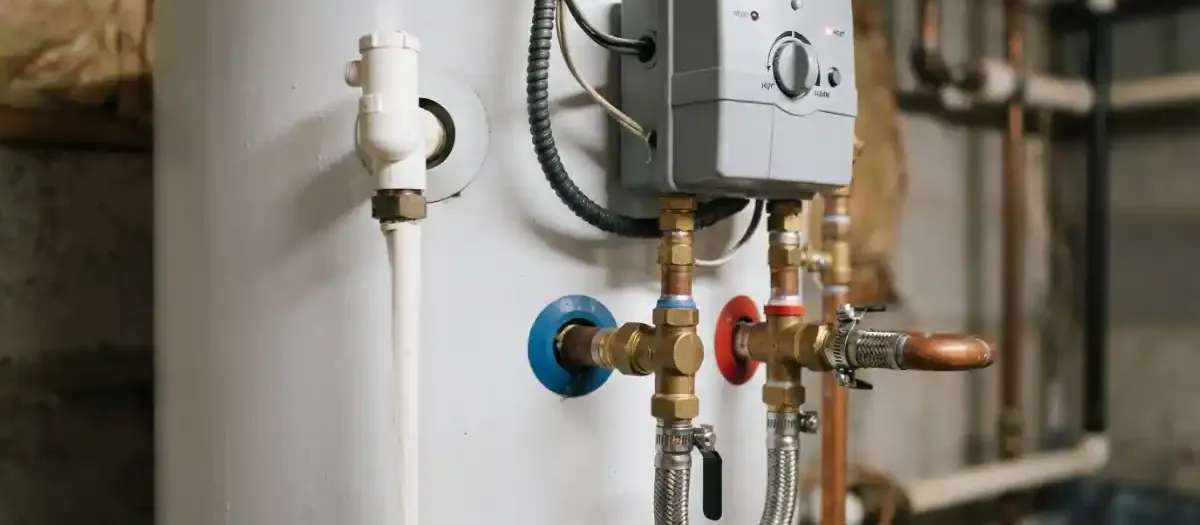
A temperature and pressure relief valve, often called a T&P valve, opens if the tank gets too hot or too pressurized. It is the last line of defense if the thermostat fails.
A tank that cannot relieve pressure can rupture. That is why every storage water heater has one, and why it must never be capped or blocked.
Signs the valve needs attention
Constant dripping
A weeping valve may be worn, or the tank pressure is too high.
Rust or crust at the outlet
Mineral buildup or corrosion means the seat may not close.
Valve will not lift
A lever that is frozen with scale cannot do its job.
Hot water discharge
A valve that opens fully points to over-temperature or pressure.
If the valve is discharging steam or scalding water, stay clear, shut off the fuel or power and call for help. See our water heater repair page.
Installing or replacing the valve
Shut off power or gas
Turn off the electric breaker or gas control and close the cold water inlet.
Relieve pressure
Open a hot faucet and drain the tank a few gallons below the valve.
Remove the old valve
Take off the discharge pipe, then unscrew the valve with a wrench.
Install the new one
Wrap the threads with the correct sealant, tighten and reconnect the discharge pipe.
Match the rating on the valve to the tank. Using a valve with the wrong pressure or temperature setting is unsafe.
The discharge pipe rules
- The pipe must be as large as the valve outlet.
- It runs downward with no traps, no valves and no threads on the end.
- It ends a few inches above a floor drain or outside.
- It must not be capped, plugged or reduced.
- It should be a material approved for hot water.
The purpose is to carry scalding water to a safe place. A pipe that points toward a person or dead-ends is a hazard.
The North Olmsted angle
Swapping a water heater is plumbing work, so ask the Building Division at 5200 Dover Center Road whether your job needs a permit. The inspector reviews the work against the 2024 Ohio Plumbing Code and will look at the relief valve and its discharge pipe. Inspections are booked by the permit holder.
Test the valve once a year
Place a bucket under the discharge pipe, lift the lever briefly and let it snap back. Water should flow and then stop. If it drips afterward, the valve may need replacing.
If the lever does not move or no water flows, do not force it. Call a plumber. A stuck valve is a safety risk.
Thermal expansion and repeated discharge
A valve that opens every time the heater cycles often points to thermal expansion on a closed system. If your house has a backflow preventer or a pressure-reducing valve, water cannot flow back into the main, and pressure rises as the water heats. An expansion tank solves that.
The cause is rarely the valve itself. See water heater installation for how we size and add expansion tanks.
Where we replace valves
We replace valves during water heater repair visits in North Olmsted and in Westlake and Fairview Park. If your heater is more than a decade old, it is often wiser to look at water heater replacement as well.
Choosing the right replacement
A relief valve is chosen by its pressure rating, its temperature rating and its capacity in BTU per hour. The tank label lists the working pressure, and the valve must open at or below it. The capacity must at least match the heater input.
Do not guess. Take the tank label details and the old valve to the supplier, or ask a plumber to match them. The wrong valve either leaks constantly or fails to open when it should.
Safety steps while you work
- Turn off the fuel or power first, and let the water cool.
- Relieve pressure through a hot faucet before you open anything.
- Wear gloves and eye protection near hot fittings.
- Keep your face away from the discharge opening.
- Never plug or cap a relief valve, even temporarily.
If a valve is stuck open or you cannot shut off the heater safely, close the cold water inlet and call a plumber. Scalding water is a real injury risk.
What an inspector looks for
During a water heater inspection, the inspector checks that the relief valve is the right rating, that it is installed in the tapped opening on the tank, and that the discharge pipe is the right size and material. They also look for a safe termination point.
The pipe should not be threaded at the end, since a threaded end invites a cap. It should not run uphill, and it should not have a valve in it. If the heater is in an attic or on an upper floor, a drain pan with a drain line may be required.
Having these items right before the inspector arrives saves time and a second visit. If you are unsure, a plumber familiar with local practice can walk through the list.
Signs it is time for a new water heater
A relief valve that leaks repeatedly, rust at the tank seams, water pooling at the base and a tank more than a decade old are signs the heater is near the end of its life. Replacing the valve will not fix a failing tank.
If you see several of these signs together, plan for a replacement before the tank fails, and choose the time yourself rather than on a Sunday night.
Keep the area around the heater clear
Leave at least a few feet of clear space around the heater and its discharge pipe. Do not stack boxes or paint cans next to a gas unit, and keep flammable liquids away.
A clear area lets you check the valve, spot a drip early and reach the shutoffs in an emergency.
Standards behind the valve
Temperature and pressure relief valves are certified to ANSI Z21.22 and installed under the plumbing code, which in Ohio is based on the International Plumbing Code (IPC). Always use a valve with the right ratings for your tank.
Questions homeowners ask
About once a year. Lift the lever with a bucket in place and confirm it reseats.
The seat may be worn, or the system pressure may be high from thermal expansion.
Many homeowners can, if they shut off power or fuel and relieve pressure. If the heater is gas or hard to reach, hire a plumber.
No. A capped pipe defeats the purpose of the valve and is dangerous.
The city requires permits for plumbing work. Ask the Building Division whether a valve replacement qualifies.
Have a question that is not here? Call (440) 468-0237.