
Start by naming the problem
Filters are tools for specific jobs. Chlorine taste is one job. Sediment is another. Lead, PFAS or other contaminants are a third and need certified testing, not a guess.
Write down what bothers you about the water. If it is taste or odor, a carbon filter may be enough. If it is a health worry, get the water tested by a certified lab and use a filter certified for that contaminant.
Four common sink options
| Type | Good for | Limits |
|---|---|---|
| Faucet-mount filter | Quick taste improvement, renters | Low capacity, slows flow |
| Countertop filter | No plumbing work | Takes counter space |
| Under-sink carbon filter | Taste, odor, some sediment | Needs cartridge changes |
| Under-sink reverse osmosis | Broad contaminant reduction at one tap | Wastes some water, needs a drain connection and tank |
We make no health claims for any system. Match the certification on the box to the contaminant you care about.
What an under-sink install involves
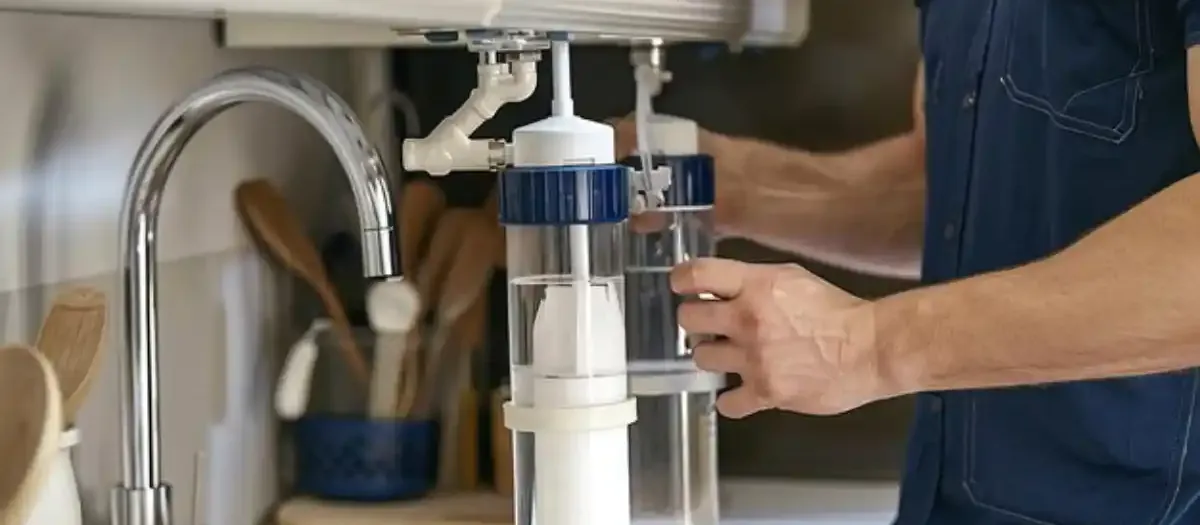
A typical under-sink system taps the cold line with an adapter, runs tubing to the filter housing and sends filtered water to a dedicated faucet or the main one. A reverse osmosis system adds a drain saddle, a storage tank and a small faucet.
The work is usually quick, but the details matter. A saddle valve that leaks behind a cabinet wall causes real damage. A proper compression connection or a tee fitting is more reliable. If your sink has a garbage disposal, check clearance before you buy.
The North Olmsted angle
Cleveland Water publishes an annual water quality report. Its 2025 figures put hardness between 105 and 130 ppm, averaging 117, which is moderately hard. Hardness is a mineral issue, not a safety one, and a sink filter does not soften water. Check which utility serves your street and read its latest report, then decide whether you want taste filtering, a softener or both.
Hardness, scale and a sink filter
A carbon filter does not remove hardness minerals. Scale will still form on the faucet, and the cartridge itself can clog faster in hard water. Reverse osmosis does lower minerals at the tap, but it only serves that tap.
If scale is your main problem, a whole-house water softener is the right tool. If taste is the problem, a sink filter is cheaper and simpler. Many homes use both.
Cartridge changes: the real cost
The price of a filter is the housing plus every cartridge after it. Skipping changes lets the filter pass what it was supposed to catch and can grow bacteria in the cartridge.
Pick a system with cartridges you can buy easily, and put the change date on the calendar when you install it. If you hate chores, choose a system with a long cartridge life or a service plan.
Whole-house versus sink-only
Sink-only filter
- Lowest cost and quick to install
- Targets drinking and cooking water
- Does not protect pipes or heater
- Easy to replace or move
Whole-house filter
- Treats every tap and appliance
- Protects equipment from sediment
- Higher cost and a larger footprint
- Needs correct sizing and a bypass
If your main goal is better drinking water, a sink filter is enough. If sediment or chlorine bothers you everywhere, whole-house filtration makes more sense. For installs in your neighboring towns, we also serve North Ridgeville and Olmsted Township.
Questions to ask before you buy
- Is the filter certified for the contaminant I care about, and by whom?
- What is the cartridge cost per year, not just the housing price?
- Does the system waste water, and where does it drain?
- Will it fit under my sink with the disposal and trash pull-out?
- Who services it if it leaks?
Reading a filter label without being fooled
Packaging claims are loud and certifications are quiet. A box may say it reduces contaminants, but the useful information is which independent body tested it and for what. Look for the certification mark and then the performance data sheet, which lists each substance and the reduction rate.
A filter certified for chlorine taste is not automatically certified for lead or cysts. If a contaminant matters to you, find it by name on the data sheet. If it is not there, the filter is not tested for it.
Installing safely under the sink
Most leaks from a new filter come from the connection to the cold supply. A saddle valve that pierces the pipe is quick but fails more often than a proper tee fitting with a shutoff. Plastic fittings need hand tightening plus a small turn, because overtightening cracks them.
After you finish, open the cabinet and check for drips with a paper towel after an hour, again after a day and again after a week. Put a small tray under the housing so a slow leak shows itself before it damages the cabinet floor.
A reverse osmosis unit also needs a drain connection above the trap. If your sink has a disposal, the air gap or the drain saddle needs a clean location, and sometimes a plumber has to move something to fit it.
Keeping a filter system working for years
A filter is a consumable system, so treat it like one. Write the install date on the housing and set a reminder for the first change. Keep spare cartridges on hand so you are never tempted to run an exhausted one.
Flush a new cartridge as the maker directs. Carbon fines can make the first glass cloudy or gray, which is harmless but unpleasant. If the flow drops sharply before the scheduled change, the cartridge may be clogged with sediment, and a prefilter can extend its life.
If the water develops an odd smell after a long absence, such as a vacation, run the tap for a couple of minutes and replace the cartridge if the smell persists. Standing water in a damp housing is a place where bacteria can grow.
Standards to look for on the box
Independent testing is done to NSF/ANSI standards. NSF/ANSI 42 covers taste and odor, NSF/ANSI 53 covers health-related contaminants and NSF/ANSI 58 covers reverse osmosis systems. Match the standard to the problem you want to solve, and check the certifier's listing.
Questions homeowners ask
Only if you want broad reduction at one tap and accept the waste water and space. A carbon filter is enough for taste in many homes.
No. Softening needs a water softener. A filter treats other things.
It depends on the model and your water, commonly every several months. Follow the maker schedule.
Your utility publishes an annual water quality report. Read it, and test your tap if you have specific concerns.
Yes. Tell us the model and the sink layout. We check clearance and drain access before we start.
Have a question that is not here? Call (440) 468-0237.