
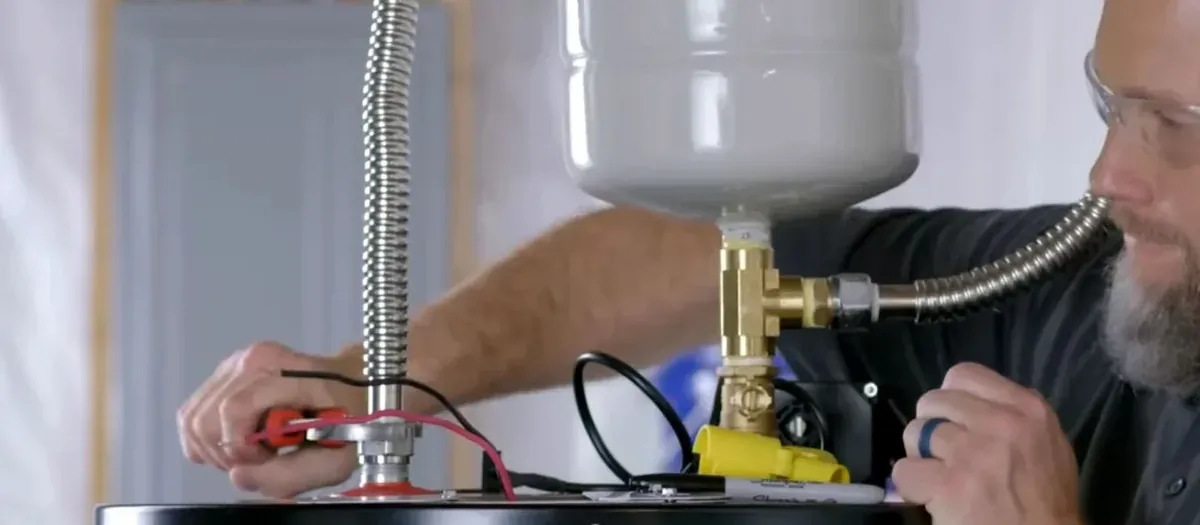
What an expansion tank does
When water heats, it expands. In an open system, the extra volume pushes back into the city main. In a closed system, it has nowhere to go, so pressure rises.
An expansion tank is a small vessel with an air cushion. It absorbs the extra volume and keeps pressure in a safe range.
Is your system closed?
- A backflow preventer on the service line closes the system.
- A pressure-reducing valve with a check valve also closes it.
- A water meter with a check valve counts too.
- If you see a relief valve dripping, pressure may be rising.
- A gauge on a hose bib can show if pressure spikes after a hot water run.
If any of those apply, thermal expansion is a question to ask your plumber. See water heater installation for how we check.
Tankless versus tank: does it matter?
Storage tank heater
- Heats a large volume of water
- Expansion can be large
- Tank often required on closed systems
Tankless heater
- Heats water on demand, little stored
- Expansion is small, but not zero
- Manufacturers may still call for a tank or relief
Some manufacturers require an expansion tank on closed systems, and some specify one for recirculation loops. Always read the installation manual for your unit.
Recirculation loops and hot water return
A recirculation loop with a pump holds hot water in a loop of pipe, which is a closed volume that can expand. Many tankless installs add a small tank on the hot side for that reason.
Ask the installer whether your unit has a built-in buffer or relief and whether the loop needs a tank. The answer depends on the model.
The North Olmsted angle
Backflow devices come up in Ohio water supply rules, and many utilities require them on certain connections, which can close a home plumbing system. Check with your water supplier and the North Olmsted Building Division, which issues plumbing permits under the 2024 Ohio Plumbing Code. They can tell you whether your service has a backflow device and whether the inspector will look for thermal expansion control.
Sizing and setting a tank
An expansion tank is sized to the volume of water in the system and the water pressure. The air charge must be set to match the house pressure before it is installed.
A tank with the wrong charge does not work. After installation, check pressure on a gauge when the water is cold and again after the heater has run.
Signs you need one
Relief valve drips
The valve opens during heating because pressure peaks.
Banging or hammer
Pressure spikes make pipes knock after fixtures close.
Leaking fixtures
High pressure stresses faucet seals and supply lines.
Short appliance life
Chronic high pressure wears out washers and heaters.
Talk to a plumber
If you are planning a tankless water heater, ask about thermal expansion up front. We serve North Olmsted, Westlake and Olmsted Township, and we check pressure before we recommend a tank.
Installing and checking an expansion tank
Check pressure first
Measure house water pressure with a gauge on a hose bib before you choose the tank.
Set the air charge
Match the tank air pressure to the house pressure using a tire gauge and a pump.
Install on the cold line
Connect with a tee near the heater and support the tank so its weight is not on the pipe.
Test the system
Open the water, heat the system and confirm pressure stays steady and the relief valve stays dry.
A tank that has lost its air charge or has a failed bladder looks fine from outside. Tap the tank with a knuckle. A healthy tank sounds hollow at the top and solid at the bottom, and a waterlogged tank sounds solid all the way.
Maintenance and replacement
Expansion tanks do not last forever. The rubber bladder wears, and the air charge leaks away slowly. Check the charge once a year while the system is depressurized, and replace the tank if it is waterlogged or rusted.
If your relief valve keeps dripping after you have added a tank, have a plumber check the charge, the sizing and the incoming pressure. See tankless water heater for what we inspect on a service call.
Pressure basics every homeowner should know
Normal household water pressure falls in a moderate range, and pressure above that range stresses everything in the house. A pressure-reducing valve, usually near the main shutoff, keeps it in check. When it fails, pressure rises and fixtures begin to leak.
Buy a simple pressure gauge that screws onto a hose bib and check it twice a year. Check it with no water running, and again after the heater has run for a while. If it climbs after heating, thermal expansion is at work.
Report a high reading to a plumber. Fixing pressure early protects the heater, the washing machine, the dishwasher and the supply lines.
A note on what we will not guess
We cannot tell from a web page whether your house needs an expansion tank. The answer depends on your service line, your meter, your pressure and the heater you choose. A short visit with a gauge answers it.
If a company says you definitely need one or definitely do not before measuring anything, ask how they know. A good plumber measures first and recommends second, and puts the reason in writing.
Keep records for the future
Write down the date of the install, the tank size, the air charge you set and the house pressure you measured. Tape the note near the heater or keep it with the manual.
The next person who works on the system, or the buyer of your house, will thank you. A tank with a documented charge is easy to check and easy to trust.
Code reference
Thermal expansion control is addressed in the International Plumbing Code (IPC), which the Ohio Plumbing Code follows. The tank maker's instructions say how to size it and set the air charge, and an inspector will want to see it where the system is closed.
Questions homeowners ask
No. It depends on whether the system is closed and what the manufacturer requires.
A backflow preventer, a check valve at the meter or a pressure-reducing valve can close it. A plumber can confirm.
Pressure or temperature is too high. Thermal expansion is a common cause.
You can, but sizing and air charge matter. Many homeowners hire a plumber.
On the cold supply near the heater, supported so the pipe does not carry the load.
Have a question that is not here? Call (440) 468-0237.