
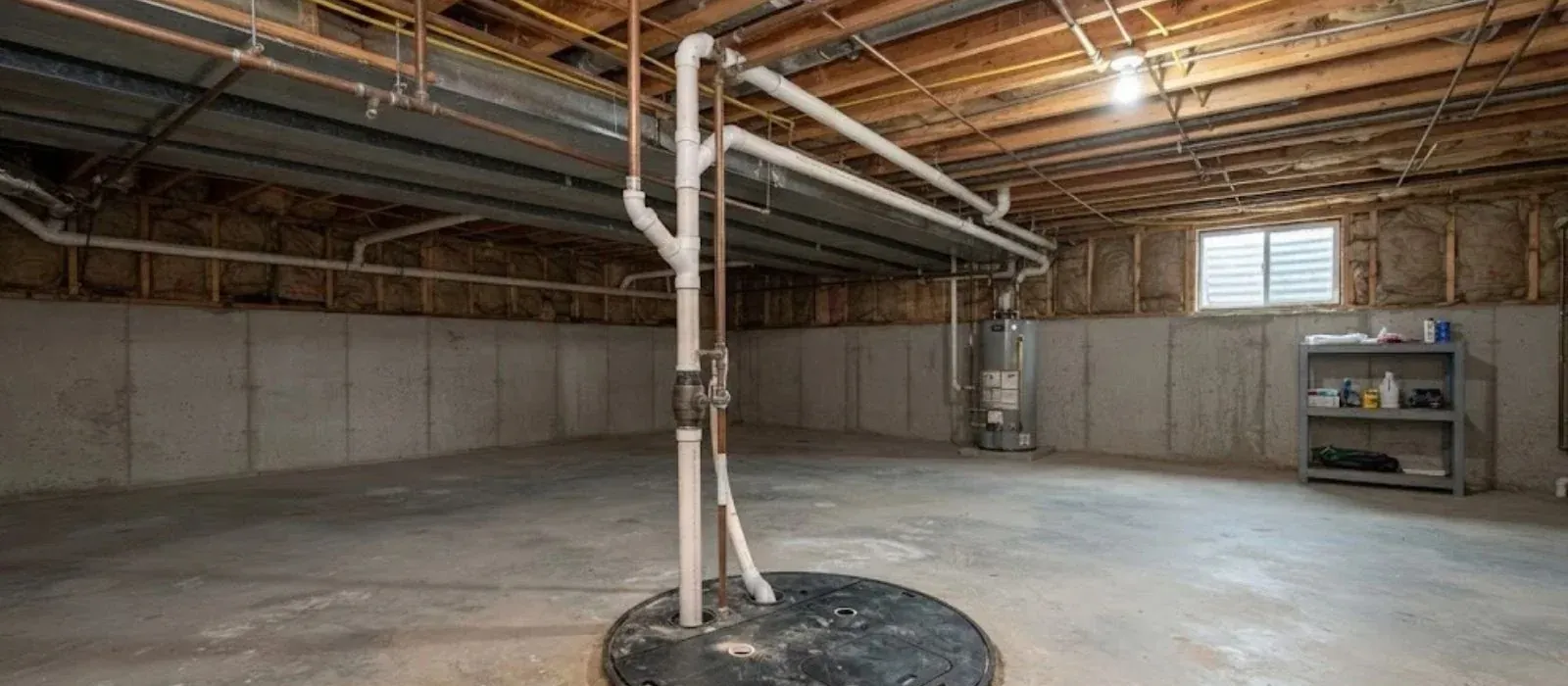
Fix the water before you pick the floor
No flooring is truly waterproof if water keeps coming in from the slab, the walls or a failed sump. A floor that traps moisture grows mold underneath and fails sooner than the same floor over a dry slab.
Before you buy anything, find out where your basement water comes from. A sump pump that runs, a gutter that dumps beside the wall and a hairline crack that weeps after rain each need a different fix. Our basement waterproofing page explains the options.
A simple moisture test
Tape a plastic sheet
Tape a two-foot square of clear plastic to the slab, sealing all four edges.
Wait 24 to 48 hours
Leave it alone, ideally after a stretch of humid or wet weather.
Look underneath
Condensation on the slab side means moisture is moving through the concrete.
Check the walls too
Look for white mineral deposits, damp patches and peeling paint along the walls.
This is a rough test, not a measurement. For a formal reading, ask a flooring contractor for a moisture meter or calcium chloride test.
Flooring options compared
| Option | Water behavior | Notes |
|---|---|---|
| Luxury vinyl plank (rigid core) | Water resistant, good if dried quickly | Seams can admit water, popular and comfortable |
| Porcelain or ceramic tile | Excellent, does not absorb water | Cold and hard, grout needs sealing |
| Sealed or epoxy concrete | Resists moisture, still lets vapor through unless rated | Simple and durable |
| Interlocking rubber or polyethylene tiles | Drain through seams, floors can be lifted and dried | Good for utility areas |
| Carpet and laminate | Poor in wet basements | Avoid unless the basement is reliably dry |
The North Olmsted angle
On May 12, 2014, a storm flooded about 1,000 homes across Olmsted Falls, North Olmsted and Westlake. The City of North Olmsted requires a cover on sump pump pits under Section 1339.01 and bars downspouts and footing drains from the sanitary sewer under Section 911.07(j). A floor choice should assume that a sump failure or a sewer backup can still happen.
Choose for the worst day, not the average one
If your basement has flooded once, plan for it to flood again. A tile or sealed concrete floor survives a few inches of water and can be cleaned. Rigid vinyl plank can survive if you lift the planks and dry the slab quickly, though it may need replacing.
Skip anything that glues to the slab with organic backing or soaks up water. Plan for removable rugs instead of wall-to-wall carpet.
Prep and installation notes
- Clean the slab and repair cracks with a flexible filler.
- Use a vapor barrier or a primer rated for below-grade use.
- Leave a small gap at the walls so the floor can expand.
- Keep furniture and storage off the floor on legs or shelves.
- Check that the floor drain is clear before you install.
A basement floor drain that backs up will ruin new flooring. If your drains are slow, book drain cleaning first.
Protect the new floor with the right equipment
A reliable sump pump with a battery backup, a check valve and a clean discharge line is the cheapest insurance for any basement floor. The pump pit should have a cover, and the discharge should go outside, away from the foundation.
See sump pump installation and repair for how we test and replace pumps. For houses in North Ridgeville or Olmsted Township, where creeks and low spots add flood risk, the same advice applies.
A practical order of work
- Fix leaks and drainage outside the house.
- Service the sump pump and test the backup.
- Clear floor drains and the main line.
- Test the slab for moisture.
- Choose the floor that survives a bad day.
Walls, trim and the details around the floor
A waterproof floor is only part of a dry basement. Wall finishes that touch the floor can wick moisture upward, and wood trim sitting on the slab will rot in a wet event. Use moisture-resistant materials near the floor, or leave a gap and trim with PVC.
Keep stored items off the floor on plastic shelves. If a water event happens, you want to lift things out in minutes, not carry soaked boxes up the stairs.
When the basement has a history of water
If a basement has flooded before, document it. Note the date, the water level and what caused it, because that history helps you choose materials and plan a pump. It also helps when you talk to an insurance agent about coverage.
Sewer backup coverage is often a separate endorsement on a homeowner policy, so ask what yours includes. Flood damage from groundwater and damage from a backed up sewer or sump are treated differently by many policies, and the answer is worth knowing before a storm.
Cost drivers to think about without a price list
Flooring cost follows four things: the material, the prep, the size and the labor. Tile and sealed concrete take more prep, and vinyl plank takes less. Slab repair, crack filling and moisture primer add to the total in a basement with problems.
Ask each contractor for a written scope that lists prep, materials and what happens if the slab shows moisture. A bid that skips prep is cheaper up front and costlier later.
Do not forget the cost of the pump, the drains and any exterior drainage. A floor that sits on a dry slab lasts years longer than one installed to cover a wet problem, so the cheapest plan is often to fix water first.
Talking to your insurance agent
Before you finish a basement, ask your agent what the policy covers for water damage and sewer backup. Many policies treat them differently, and coverage for finished spaces may need an endorsement.
Keep receipts for flooring, pumps and drains. They support a claim if something goes wrong later.
Standards for testing a slab
Flooring makers usually require a moisture test before installation. Common methods are described in ASTM F2170 for in-slab relative humidity and ASTM F1869 for calcium chloride testing, according to the flooring industry. Ask your contractor which test they use and what reading your floor needs.
Questions homeowners ask
Tile and sealed concrete tolerate water best. Rigid-core vinyl plank is a popular compromise if you control moisture.
It is not wise. Find and fix the moisture source first, or the floor will fail and mold can grow underneath.
Section 1339.01 of the city code requires a cover on sump pump pits. Ask the city for details on your property.
No. Flooring only changes how the basement handles water that gets in. Drainage and pumps keep it out.
Do waterproofing and drainage first. Flooring goes last.
Have a question that is not here? Call (440) 468-0237.