
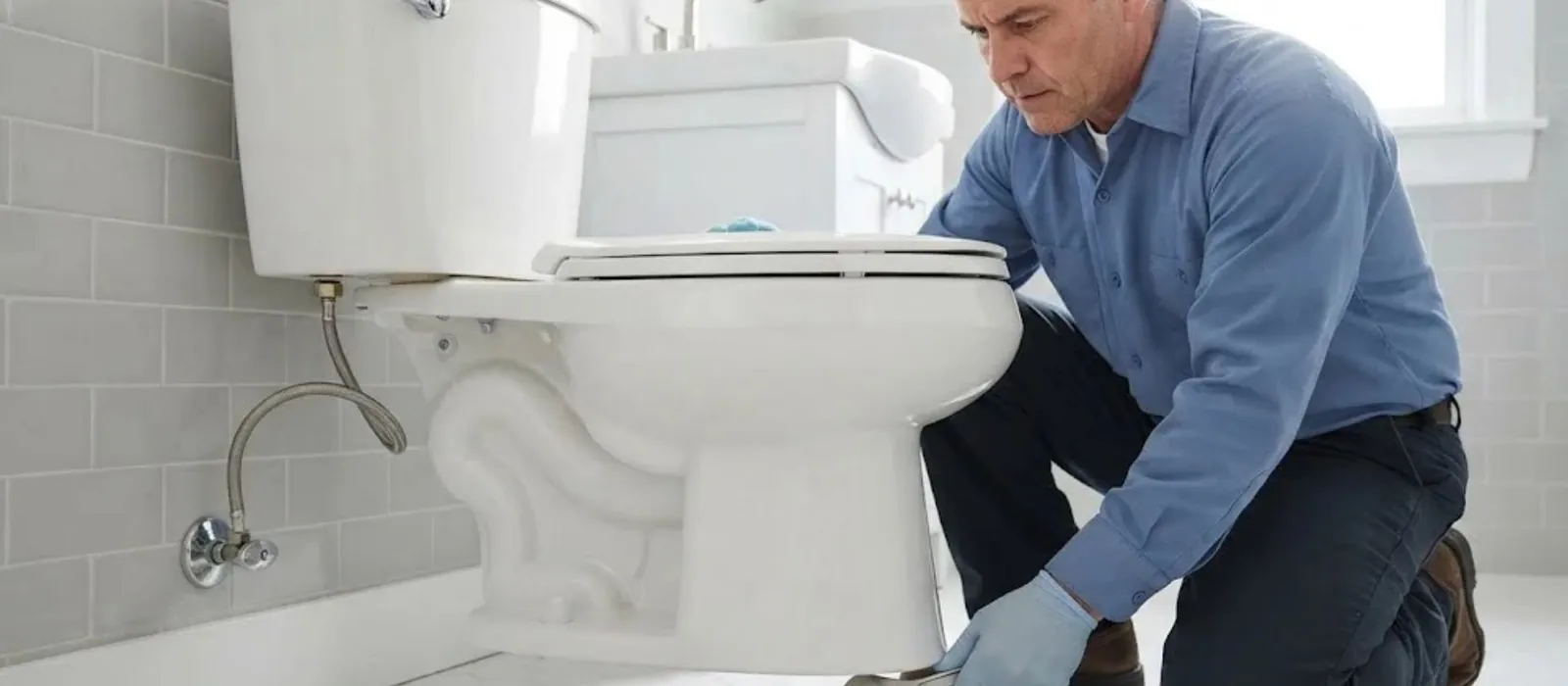
What tank bolts do
Two bolts pass through the bottom of the tank and secure it to the bowl. A rubber washer inside the tank and a gasket between the tank and the bowl seal the connection.
If water drips from the back of the toilet between the tank and bowl, the bolts, washers or gasket are the usual cause.
Confirm the leak is at the bolts
Dry the outside of the tank and bowl, then press paper towels against the bolts and the gasket area. Wait a few minutes. A damp spot at a bolt head or between the tank and bowl means a seal has failed.
Condensation on the outside of a cold tank can look like a leak. If the water appears only in humid weather and the bolts are dry, an insulated tank liner or a mixing valve may help.
Parts you need
| Part | Notes |
|---|---|
| Tank bolts, brass or stainless | Avoid cheap steel that rusts again |
| Rubber washers | Go inside the tank on each bolt |
| Brass or metal washers | Spread the load on the porcelain |
| Tank-to-bowl gasket | Replace it whenever the tank comes off |
| Wrench and screwdriver | To hold the bolt and turn the nut |
A tank-to-bowl kit costs little and has all of these parts. Buy a kit matched to your toilet brand if you can.
Step-by-step replacement
Shut off and drain
Close the supply valve, flush and sponge out the remaining water.
Disconnect the supply
Unscrew the supply line from the bottom of the tank.
Remove the bolts
Hold the bolt head inside the tank and unscrew the nut underneath. Cut rusted bolts with a hacksaw blade if needed.
Replace the gasket and set the tank
Lift the tank, fit the new gasket, drop in the new bolts with washers and tighten evenly.
Tighten the nuts a little at a time, alternating sides. Porcelain cracks if you overtighten or tighten one side only.
The North Olmsted angle
A median build year of 1966 for North Olmsted homes, from the Census survey profile, means many toilets here are older and some tanks are original. Old tank bolts are often steel that has rusted solid, and Cleveland Water's 2025 report lists hardness of 105 to 130 ppm, so mineral scale can also seize nuts. Penetrating oil and patience help, and a cracked tank on an old toilet is a good reason to replace the whole toilet.
Common problems and fixes
- Bolts spin and will not tighten: hold the head inside the tank with a screwdriver.
- Tank wobbles: add or replace washers and tighten evenly.
- Gasket still leaks: make sure the sealing surfaces are clean and the gasket is seated.
- Hairline cracks near the bolt holes: replace the tank or the toilet.
- Water from the base of the toilet: this points to the wax ring, not the tank.
When to call a plumber
If the tank is cracked, the shutoff valve leaks, or the toilet rocks and leaks at the floor, call a pro. A toilet that has leaked for a long time can also damage the floor.
Our toilet repair crew handles all of this, and if the floor is stained, leak detection can tell whether more water is escaping.
Serving your neighborhood
We repair toilets in North Olmsted and in Westlake and Fairview Park. Bring up the age of the toilet when you call, because a replacement might be the better choice.
Dealing with seized or rusted bolts
Steel bolts in a tank rust together with their nuts, and turning them can spin the bolt head inside the tank. Spray penetrating oil on the nut, let it soak, and hold the bolt head with a screwdriver while you turn the nut.
If the nut will not move, cut the bolt between the tank and bowl with a hacksaw blade. Protect the porcelain with a rag and cut slowly. Once the tank is off, you can replace everything with fresh hardware.
Setting the tank back and testing
Lower the tank onto the new gasket so the bolt holes line up with the bowl. Insert the bolts with washers, then thread the nuts by hand. Tighten each side a little at a time until the tank sits level and firm.
Reconnect the supply line, open the valve and let the tank fill. Check for drips at each bolt, the supply connection and the gasket. Flush several times and look again, because small leaks sometimes show only after the tank cycles.
Should you replace the whole toilet instead?
Replacing bolts is a small repair on a sound toilet. If the toilet is cracked, wobbles because of a damaged flange, or has needed several repairs, a new toilet may be the better value. Newer models also use less water per flush.
Look at the age of the toilet, the condition of the porcelain and whether parts are available. A toilet from the 1960s may use much more water per flush than a modern one, which adds up across a year of use.
If you decide to replace it, plan on a new wax ring and new bolts for the base. Our crews handle the swap, the disposal of the old unit and the cleanup in the same visit.
Keeping the bathroom dry afterward
After a tank repair, keep an eye on the floor around the toilet for a week. A slow drip at the bolts can show as a tiny wet ring on the tile or a soft spot in the flooring.
Wipe the tank and bowl dry, then check with a tissue each morning for a few days. Early detection of a leak that remains costs a tissue, while late detection can cost a subfloor.
Small upgrades while the tank is off
With the tank removed, inspect the bowl rim, the flush valve opening and the supply shutoff. Wipe away mineral crust and look for hairline cracks around the bolt holes.
This is also a good moment to replace the supply line and the shutoff valve if they are old. A braided stainless line costs little and removes a common failure point.
Code and permit note
Swapping tank bolts is routine maintenance, but installing a new toilet is plumbing work under the Ohio Plumbing Code, which is based on the International Plumbing Code (IPC). If you are unsure which side of that line your job falls on, ask the Building Division.
Questions homeowners ask
The tank bolts, their washers or the gasket have worn out.
Yes. Always replace the gasket when the tank comes off.
Brass or stainless steel, so they do not rust again.
Snug and even. Overtightening can crack the porcelain.
Not by itself. A cracked tank or a leaking base is a stronger reason.
Have a question that is not here? Call (440) 468-0237.